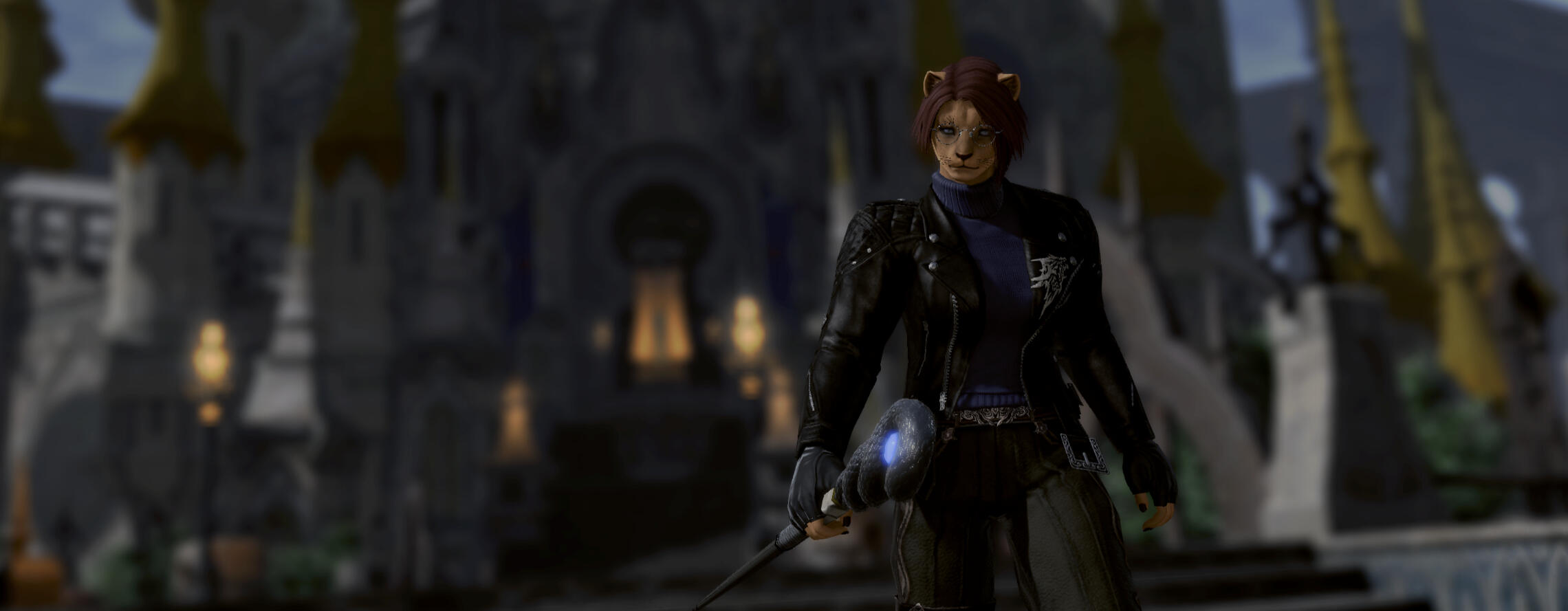
Kreja Lesjasch
Revolutionary / Mage / Academic Writer
Overview
A revolutionary who fought for many years in Bozja and Dalmasca, Kreja's initial training as a mage came from the Imperial legion she defected from upon her first opportunity. Now, she lives as a scholar and occasional adventurer, if a very selective one. However, her revolutionary spirit has neither died nor waned.
| Identity: | Mid thirties, hrothgar, she/her, lesbian |
| Relationship: | Partnered with Thejah Revache |
| Languages: | Garlean, Eorzean, Old Bozjan, Dalmascan |
| Occupations: | Scholar of social history, occasional adventurer |
| Skills: | Spellcasting, research, academic writing, stealth |
| Hobbies: | Reading, people-watching, conversation, spirits, coffee |
Quick Facts
These are either obvious when interacting with her or things your character may already know.
Bozjan. Kreja was born in Kralja, a Bozjan city. She has a small home there, but holds citizenship in both Bozja and Dalmasca; places she fought the Empire.
Impaired voice. Due to permanent injury, Kreja speaks in a raspy, near whisper and can be hard to hear. Only a strained "shout" hits average speaking volume.
Relatively small. For a hrothgar, Kreja's build is narrow and slight. While not unhealthy, she lacks the intimidating degree of musculature most have.
Published scholar. Kreja has published several works on "social history." They explore historic trends via the lives of lower-class and oppressed peoples.
Divisive reputation. A fair few scholars respect Kreja's work; others, mainly upper class, see them as propaganda, and some nations view her with scrutiny.
IC Bibliography
Each work is published in the Garlean language. Works 2 and 4 are also in Eorzean Common, while 3 is in Dalmascan. From oldest to newest, they are:
Voices of the Thunderers: Personal histories from the movement’s people.
Hunters of the Mist: The collected stories of the folkloric Bozjan outlaw-hero Lesja, by Stoja Anadica. (Garlean and Eorzean language editions).
Labor Between the Skatay Range and Dalmasca's Nebra River: A societal throughline from pre-Imperial occupation to the modern day in the region.
Bozja's Twin Revolutions. (Vol. 1–2).
Note: I reference both the Thunderers and a region of Dalmasca, both of which are bits of lore created by another player, Thejah Revache, and central to her character.
History
Kreja was born to Bozja's underclass and educated by the Empire. Raised by a destitute family, she was left to fend for herself as little more than a pickpocket and thief. After Empire pulled her from a gaol cell and into a military education program, the instructors noted a talent for magic. They trained her in basic Thaumaturgy and Conjury for eventual placement in the IVth Imperial Legion's Mage Detachment. She showed greater aptitude with the former, which became the focus of her education.The instructors worked to indoctrinate her. They failed. There are many reasons, ranging from the cruelty employed by Sadr rem Albeleo, leader of the Mage Detachment and who oversaw her training in thaumaturgy, to the many injustices the Empire was responsible for. Regardless of Gabranth's stated ideals, the Empire was rife with xenophobia and class division. Given her early life, of that, Kreja held keen awareness.She waited no longer than her first deployment to turn traitor. Within the ruins of a small, isolated bunker, members of the revolutionary group known as the Thunderers found her. While it took time to gain their trust, she joined them.For the next decade, she fought in Bozja and northern Dalmasca. After the Empire began to fracture, both provinces earned their freedom and eventually the Garlean Empire fell. She split her time between Dalmasca and her new home in Bozja where she pushes for greater reform. Now she travels more broadly.Now, she is a scholar and adventurer, but with ideals forged in revolution. An ardent supporter of the oppressed, Kreja's true purpose is to carry on the fight for them. While her life may have been brutal, just as the Empire failed to indoctrinate her, neither they nor any other hardship ever killed her heart.
Hooks
Divisive scholar always seeking stories. A scholar who arose from a revolution, Kreja is a published, academic author on the subject of social history. She's always interested in the stories of common folk, criminals, and others beneath the upper crust of society.
Mage who both loves to learn and share knowledge. Kreja is open to speaking with fellow mages and others interested in the subject of aetherology. This is not limited to thaumaturgy, either. She has a general understanding of conjury and has some interest in arcane geometries. Any form of spellcasting is interesting.
Recognizable revolutionary from Bozja and Dalmasca. For roughly a decade, Kreja fought with one of the revolutionary movements opposing the Garlean Empire in Southern Ilsabard after she turned traitor from the IVth Imperial Legion. Anyone who lived or fought in these regions may have known her or recognize her. Note, she was not present on the Southern Front, but was briefly in Zadnor, during the events of Save the Queen.
Political agitator for anyone who will listen. With a long history as a resistance fighter a revolutionary scholar, Kreja will gladly speak to the inequities of social orders across the star to anyone who will listen. That includes not only like-minded individuals, but those who take issue with her work.
Adventurer willing to be hired for the right job. While not her primary occupation, Kreja does still take odd jobs. It is rare for her to take a job from a Grand Company, however. Most often, she limits herself to poorer folks in need, and especially those who are outcasts of their societies. The legality of these jobs is not her primary concern. The ethics and morality of them are.
Gallery


Out of Character
I'm Qrreia (she/her), an internet lioness, and a hobbyist writer and worldbuilder with a focus on social science fiction.FFXIV's narrative touches on a variety of difficult political and social topics. I like to linger on those themes, explore them more fully, and hopefully do my small part to make the world feel a little more lived in. Not that all of my RP is so serious, of course, but it does form my foundation.I'm a paragraph RPer, but I use whatever length is right for the post. Sometimes a single word says it all. I also tend to prefer close lore adherence. This mostly just means I don't like contradicting the game, but I have no problem filling in the gaps and expanding that lore. It just needs to fit the setting and FFXIV's is very broad.I'm on Mateus, on the Crystal Data Center, but I'm good with traveling. My best times are evenings (PT) except on Thursdays. I'm also busy every other Sunday.
For Awareness
This character touches on difficult topics. These range from systemic oppression, xenophobia, imperialism, colonialism, violence, trauma, and revolutionary politics. However, while she can be melancholic at times and fiery at others, I'm playing her at a relatively good point in her life and she's pretty chill as a baseline.Kreja has strong views, and IC actions have IC consequences. Be mindful if you engage with her on a character open about being a Garlean loyalist, pro-nobility, an exploitative merchant or industrialist, or the like. She's going to be disdainful or passive aggressive.That's not intended as an OOC slight, it's just her logical IC reaction, and IC is not OOC. I don't assume a player with a loyalist character is actually an Imperialist. But disallowing IC consequences gives tacit OOC acceptance toward those stances.I don't go for romance RP. I mean, I do, but only with folks I know very well.
Bozja's Twin Revolutions. (Vol 1-2).
As Bozja enters a new, post-Imperial age, some Bozjans call to maintain the nation’s caste system, one of the few cultural touchstones the Garleans left standing, if not even return rule to a Queen for the first time since the Fourth Umbral Calamity. Another seeks a new future instead of a return to the inequities of the past. This work presents this scenario through the lens of the “Twin Revolutions.”One, the youngest, is that of the Bozjan people across the strata of social class against the occupying Empire. The other, older and still active, is that of the Bozjan underclass against their domestic exploiters; with the scope of that category ranging between individual movements. The work explores the trends that lead to these revolutions from the perspective of Bozja’s underclass, including the Empire’s manipulative co-opting of their plight in it’s initial invasion, and incorporates new facts learned about the Bozjan royalty during the late stages of the revolution against Garlemald.It is Kreja’s driest and most rigorous academic work, and longest between its two current volumes. However, no less clear is its argument for change beyond what even figures like Bajsaljen Ulgasch, a modern torchbearer of that second revolution, call for.
Change in Dalmasca Between the Skatay Range and the Nebra River: A Societal Through-line from Pre-Imperial Occupation to the Modern Day
This work explores the history of laborers within a small region of Dalmasca, previously occupied and industrialized by the Garlean Empire. The book outlines the perspective of the local workers who served under the occupation, and traces their historic lineages through eras under Dalmascan rule. From there, the book draws together these threads to explain what made the region respond so well to political change following the end of the revolution against the Empire.While a fair few scholars have considered it a serious academic text, others, often among nobility, declare it either a work of propaganda or a fanciful interpretation that commoners and the division of labor could have such an effect on society.
Hunters of the Mist: The Collected Stories of the Folkloric Bozjan Outlaw-Hero, Lesja; the Translated Garlean and Eorzean Language Editions
Originally published in 1289 of the Sixth Astral Era by Stoja Anadica, this omnibus collects a narrative retelling of a hrothgar clan lead by the outlaw folk hero, Lesja. Largely unknown across most of the star and obscure even in modern Bozja, it was one of a plethora of books banned once the Empire established its hold on the nation. The original author also wrote it in the now equally obscure Old Bozjan language.Kreja Lesjasch translated this work into both the Garlean and Eorzean tongues. She also included a forward explaining why the story was so important to her that she changed her surname, originally assigned to her by Imperial clerks, to honor this folkloric revolutionary figure.You can also read the forward to these editions, which covers the history of the book.((But why though? I don't even know why I wrote it!))
Voices of the Thunderers: Stories from the Movement’s People
This book contains two-dozens stories from members of the revolutionary group known as the Thunderers, including the author's own. Recounted while fighting in northern Dalmasca, the stories explain what brought these individuals into the movement.Kreja Lesjasch’s first published work is also her most derided. While noted for the heartfelt stories and surprising vulnerability on display, even scholars more receptive of her viewpoint feel the work lacks sufficient rigor. Furthermore, with her inherent bias as part of the movement, many have dismissed the book as little more than cherry-picked propaganda.
Foreword: A brief history of Hunters of the Mist
You now hold a restored edition of Hunters of the Mist by Stoja Anadica, an omnibus that collects a narrative retelling of a hrothgar clan lead by the outlaw folk hero, Lesja, who may have once even existed.It is more than likely you are not yet familiar with these tales, as Imperial censors destroyed most of the copies that existed. Furthermore, Stoja wrote the original book in Old Bozjan, but few people, even those of us who are ourselves Bozjan, now speak the language. This version, the Garlean and Eorzean Common translated editions, seek to restore the forgotten figures held in these tales to our collective awareness.
Pre-Imperial history of Hunters of the Mist
Published in 1289 of the Sixth Astral Era, this omnibus includes no specific set of dates for these stories. However, they may take place in the early centuries of the Sixth Astral Era, given reference to ruins once damaged by the Great Flood. It is possible, however, that the author transposed the tale to a more recent time, when the flood was still in the generational memory of the people.Scholars, at one time, well-regarded the omnibus, but not always those among Bozja's upper class. It faced numerous difficulties due to its despotic portrayal of the Bozjan aristocracy, and the narrative's pro-equity and revolutionary message. Some editions add a forward distancing the, at the time, modern aristocracy from the period presented within the story.No mere piece of adventure fiction, the work takes a serious look at Lesja's personal life and beliefs as much as her actions. The story also gives significant attention to other members of her clan, reinforcing that Lesja as no solitary figure of greatness, but a member of a supportive community. It features romance, deep interpersonal connections within the clan, and their political ideology. As they were against the inherent inequity of mainstream Bozjan society, other, more propagandist works that featured Lesja often omitted these aspects, or presented her and her clan as anti-heroes or even villains.While its language would have been approachable to adult readers prior to the Garlean occupation, the work contains footnotes and an appendix of academic sources that it drew upon. This results is a piece of historical fiction in close conversation with academic text, if not one outright.It is worth note that Lesja's status as a folk hero long predates the publication of this omnibus. Numerous retellings precede it, and stories of Lesja originated in folk tales and ballads told by the common people of southern Bozja. These have existed from at least the early Sixth Astral Era, and some scholars have debated if they may have originated as early as the middle of the Fifth Astral Era.
The Abridged Garlean Language Edition: Lesja's Glory
Today, Lesja is unknown across most of the star and very obscure even in modern Bozja. Hunters of the Mist was one of a plethora of books the Empire banned once it secured its hold on the region, and most copies have been destroyed. In it’s place, Imperial propagandists worked on an approved Garlean language edition, renamed Lesja’s Glory.Nominally an abridged version of Hunters of the Mist, it is far slimmer. Published in 1561 of the Sixth Astral Era, the Empire pulled the book before widespread distribution the following year in response to the Bozja Incident. The Imperial propagandists, already concerned the work would end up a double-edged sword, worried the text might inspire a rebellious reaction with word of the disaster spreading.While based on the omnibus, the editors stripped down and rewrote it as a piece of agitprop in the guise of light adventure fiction. It renders the members of Lesja's clan as little more than background characters with none of the depth, complexity, and emotionality they have in the omnibus. It presents Lesja, instead, as a strong, unquestioned leader with her personal insecurities and more egalitarian leadership style de-emphasized. Members of the aristocracy, villains in the original story, are instead the heads of criminal empires or converted to corrupt merchants undermining Bozjan society.The Imperial propagandists repositioned Lesja as fighting to restore a better Bozja, which had not unified under a central leader since the Fourth Umbral Calamity, but it does still retain its primary appeal to common folk. The few scholars of the revolution who studied the work reached a consensus that the Empire intended to acknowledge and reinforce the support they received from some parts of Bozja’s underclass during their invasion. In this view, Lesja becomes a symbol of the people who fought for the promised unity brought by Garlean rule in hopes of achieving a better way of life. A forward included with this edition even goes so far as to frame the story as a prelude to the "peace and order the Empire brought to Bozja."If given more widespread publication, this would have also had the benefit of redirecting blame for the immense economic inequality seen in Bozja away from Imperial rule. It would have served to remind the underclass that this divide existed well before the IVth Imperial Legion arrived.Most of the overt propaganda exists only in the forward. Otherwise, unless one had read the full omnibus, the story may seem little more than pulpy schlock if one ignored the pro-Imperial message wrapped around it. In reality, it co-opted a revolutionary figure and defanged her. For many who read the limited publication, it worked.
An Authentic Revival in Garlean and Eorzean Common
With Lesja’s Glory, the Empire eradicated what little awareness remained of Lesja, her clan, and her philosophies. However, I hope to change that. I had the fortune of discovering a first edition print of Hunters of the Mist before it could meet its end in a fire pit. Already a fan of Lesja’s Glory, for it was in my home city of Kralja that its initial publication ran, I risked saving the book. After all, the Empire claimed in the forward to Lesja’s Glory that they banned the book only for its use of a “primitive tongue,” and, of course, not because they were trying to replace the original story with a farce of propaganda.This one act of sedition, it turned out, would eventually lead me to make so many more.My family, for their many faults, still spoke a bit of Old Bozjan. I picked up some of the language from them before they abandoned me. I also knew a few older folks in our impoverished community who also still spoke the language and who were glad to teach me. While I may be a scholar now, I was a thief in my youth, and the language found use among elements looking to keep their public conversations private. I had plenty of opportunity to practice, and so I could read Hunters of the Mist.However, I had to read it in secret; a difficult thing to manage when attending a Garlean military academy, I might add. This work was something of a lifeline for me, and I believe it played a major role in helping me resist Imperial indoctrination. I grew up on the streets of Kralja and survived only as a pickpocket. When the Empire arrested me, they didn't throw me in a gaol cell. They helped me in a way I cannot deny by affording me me an education instead, along with food and shelter. Yet, if the Empire presented such an extreme mischaracterization of Hunters of the Mist in Lesja’s Glory, what else had they lied to me about?Reading Hunters of the Mist cracked that false veneer. It also opened me to a new ideology; a new way of viewing the world and those around me. I understood that, while the Empire saved me, it was only to twist me into their servant. That became impossible to ignore given the horrific conditions my later instructors subjected me to. Hunters of the Mist offered me an escape during the darkest time of my life and helped me avoid becoming what they tried to make me. It is for that reason I adopted the surname “Lesjasch” after I defected from the IVth Imperial Legion and discarded the name the Imperial clerks assigned to me.While it took a few years following my defection, I was able to retrieve my copy of the omnibus. These editions are faithful translations of that original text, complete with the same footnotes and citations used by Stoja Anadica. I began work on these editions while fighting the Imperial presence in southern Ilsabard as an escape from the brutal conflict. For a second time, Hunters of the Mist helped me survive a long and difficult part of my life, albeit one I am proud of. If you are curious to learn more of that time, I invite you to read my first published, and original, work, Voices of the Thunderers. It shares not only my story, but those of many revolutionaries I fought with.Now, with the Garlean Empire fallen, I am glad to publish these translations of Stoja’s omnibus at long last. That said, I hope one day their necessity will lessen as more Bozjans reclaim our tongue. Expect a new publication of the original Old Bozjan text once I can make it happen.
Kreja LesjaschSocial historian, revolutionary, and Hunters of the Mist enthusiast